

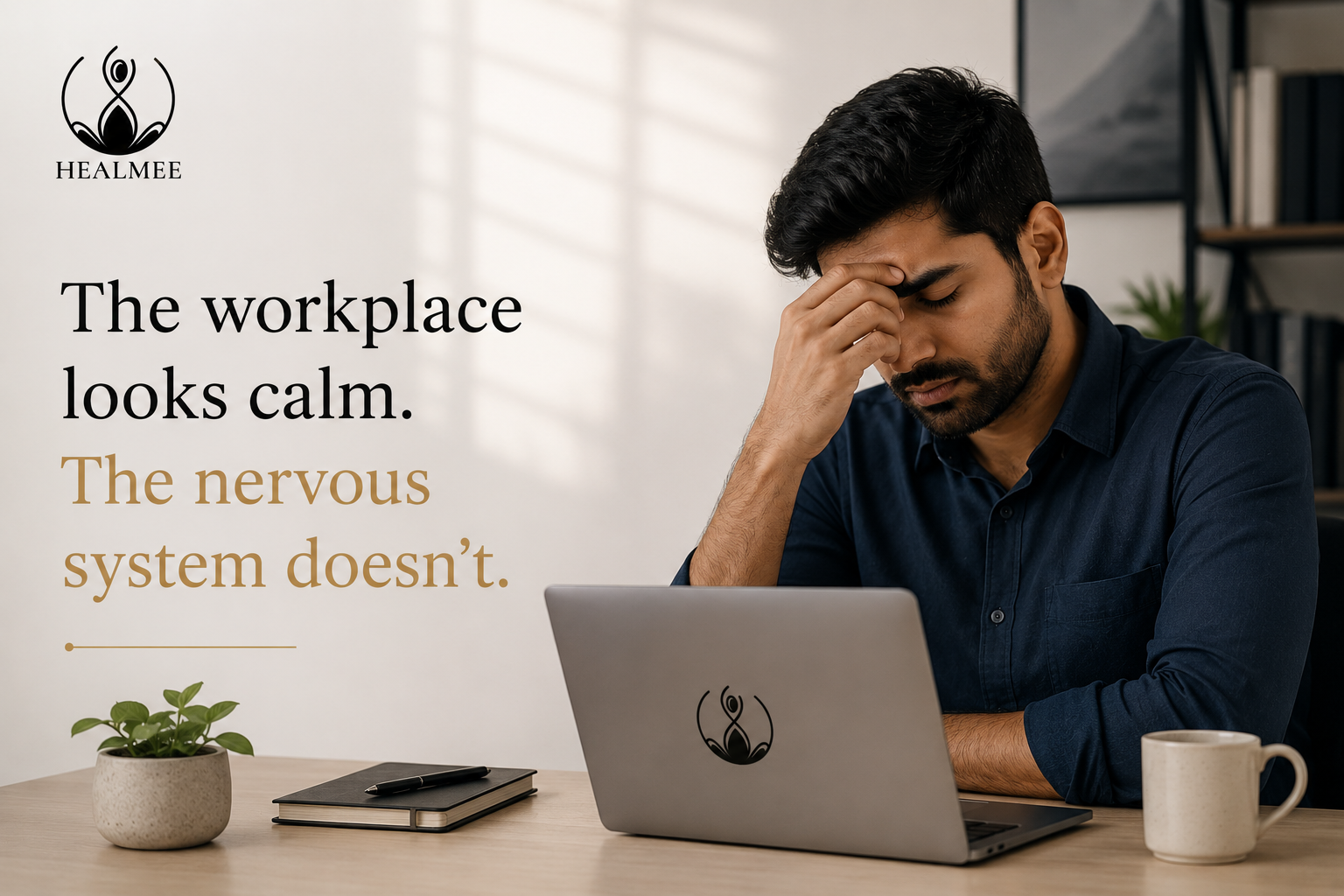
Why many workplaces are silently running on mental exhaustion
Most organisations assume exhaustion only becomes a problem when performance visibly drops. However, the reality is far more subtle.
Your Team Isn’t Burnt Out. They’re Operating From Overload long before missed deadlines, disengagement, or resignations begin to appear.
In many workplaces today, employees are still attending meetings, replying to emails, and completing tasks. Yet internally, their nervous system is operating under constant pressure. As a result, decision-making weakens, emotional resilience drops, and even simple communication starts feeling heavier than it should.
According to the World Health Organization, workplace stress has become one of the leading contributors to declining mental wellbeing and productivity globally.
Therefore, the issue is no longer just burnout. It is prolonged overload that silently affects clarity, creativity, emotional regulation, and team culture.
The Workplace Looks Functional. But People Feel Mentally Drained.
One of the biggest misconceptions about workplace wellbeing is the belief that someone is “fine” simply because they are still functioning.
However, many employees today are not truly operating from energy, creativity, or emotional stability. Instead, they are operating from survival mode.
They continue showing up because responsibilities do not pause. Meetings continue. Deadlines continue. Notifications continue.
Meanwhile, the nervous system never fully switches off.
Over time, this creates a workplace culture where exhaustion becomes normalised. People stop recognising stress because constant pressure becomes their baseline.
As a result:
- patience decreases
- communication weakens
- emotional reactions increase
- focus becomes fragmented
- creativity declines
- motivation slowly disappears
Yet externally, the team still looks productive.
That is why overload is often harder to identify than burnout.
Burnout Is Usually The Final Stage — Not The Beginning
Most people imagine burnout as complete collapse.
However, burnout rarely begins with breakdown. Instead, it starts with chronic mental overload that quietly builds over weeks, months, and sometimes years.
For example, employees may begin experiencing:
- mental fatigue despite resting
- difficulty concentrating
- emotional numbness
- irritability in conversations
- sleep disruption
- low motivation
- constant mental stimulation
- inability to “switch off” after work
Although these symptoms may appear small individually, together they create long-term emotional exhaustion.
According to the American Psychological Association – Workplace Stress, chronic workplace stress directly affects emotional wellbeing, productivity, and overall mental health.
Therefore, organisations that ignore overload often notice problems only after performance significantly declines.
By then, the nervous system has already been under pressure for too long.
The Nervous System Was Never Designed For Constant Pressure
The human mind can handle pressure temporarily. However, it was never designed to remain in a prolonged state of alertness every single day.
Unfortunately, modern workplaces unintentionally encourage constant stimulation:
- endless notifications
- back-to-back meetings
- emotional suppression
- multitasking
- unrealistic responsiveness
- pressure to always appear “fine”
As a result, employees rarely experience true mental recovery.
Even after work ends, many people continue carrying unfinished conversations, stress, and emotional tension home with them.
Eventually, rest stops feeling restorative.
This is why so many professionals say:
“I rested… but I still feel exhausted.”
Because the body may pause temporarily, but the nervous system often remains active.
High Performance Cannot Sustain Long-Term Overload
Many organisations focus heavily on productivity systems, targets, and performance metrics.
However, sustainable performance is deeply connected to mental clarity and emotional regulation.
A team operating under prolonged overload may still achieve short-term results. Yet eventually, hidden costs begin to appear:
- higher emotional fatigue
- reduced innovation
- communication breakdowns
- low engagement
- increased absenteeism
- internal conflicts
- silent disengagement
In fact, many workplaces do not have a motivation problem.
They have a nervous system recovery problem.
Because when people operate from chronic mental pressure, even highly skilled teams struggle to think clearly, collaborate effectively, or lead calmly.
Stress Is No Longer Just Personal. It Is Cultural.
Workplace stress does not stay isolated within individuals.
Instead, it spreads across teams through emotional energy, communication patterns, tension, urgency, and leadership behaviour.
For example:
- one emotionally exhausted leader can affect an entire team atmosphere
- constant urgency creates collective anxiety
- unresolved pressure reduces psychological safety
- emotional fatigue weakens trust and collaboration
Therefore, overload eventually becomes part of workplace culture itself.
This is why organisations that prioritise emotional wellbeing often experience stronger communication, healthier leadership, and better long-term performance.
Not because employees avoid responsibility.
But because regulated minds make clearer decisions.
The Solution Is Not More Motivation
Most overloaded teams do not need another productivity lecture.
They need space to mentally recover.
They need environments where clarity, emotional awareness, and nervous system regulation are valued alongside performance.
Because sustainable success is not built through constant pressure.
It is built through balance between performance and recovery.
This is where deeper inner work becomes important.
At Healmee, we often see professionals who are not lacking capability, intelligence, or ambition. Instead, they are carrying prolonged mental overload that their body and mind never fully processed.
Through awareness-based practices, guided reset experiences, breathwork, meditation, and emotional regulation techniques, individuals slowly begin reconnecting with calmness, clarity, and inner stability again.
Because sometimes the problem is not that people are weak.
The problem is that they have been mentally overloaded for too long.
Final Thought
A workplace can appear successful externally while employees silently struggle internally.
However, long-term performance cannot thrive where mental exhaustion becomes normal.
Eventually, every organisation must ask:
Are people truly functioning from clarity and energy?
Or are they simply surviving under pressure?
Because there is a difference.
And that difference changes everything.
FAQ Schema
What is workplace overload?
Workplace overload happens when employees experience prolonged mental and emotional pressure without proper recovery. Unlike burnout, overload is often less visible but gradually affects clarity, focus, communication, and emotional wellbeing.
How is overload different from burnout?
Burnout is usually the final stage of prolonged stress. Overload happens earlier when individuals continue functioning despite ongoing mental exhaustion and emotional pressure.
What are signs of mental overload at work?
Common signs include constant fatigue, irritability, low motivation, difficulty concentrating, emotional numbness, sleep issues, and inability to mentally switch off after work.
Can stress affect workplace performance?
Yes. Chronic stress can reduce creativity, communication quality, emotional regulation, productivity, and team collaboration over time.
How can organisations reduce workplace stress?
Organisations can support mental wellbeing by encouraging healthier work boundaries, emotional awareness, recovery practices, communication safety, and stress management initiatives.
Connect with us if you are looking to reset your team.https://healmee.com/contact-us/
