

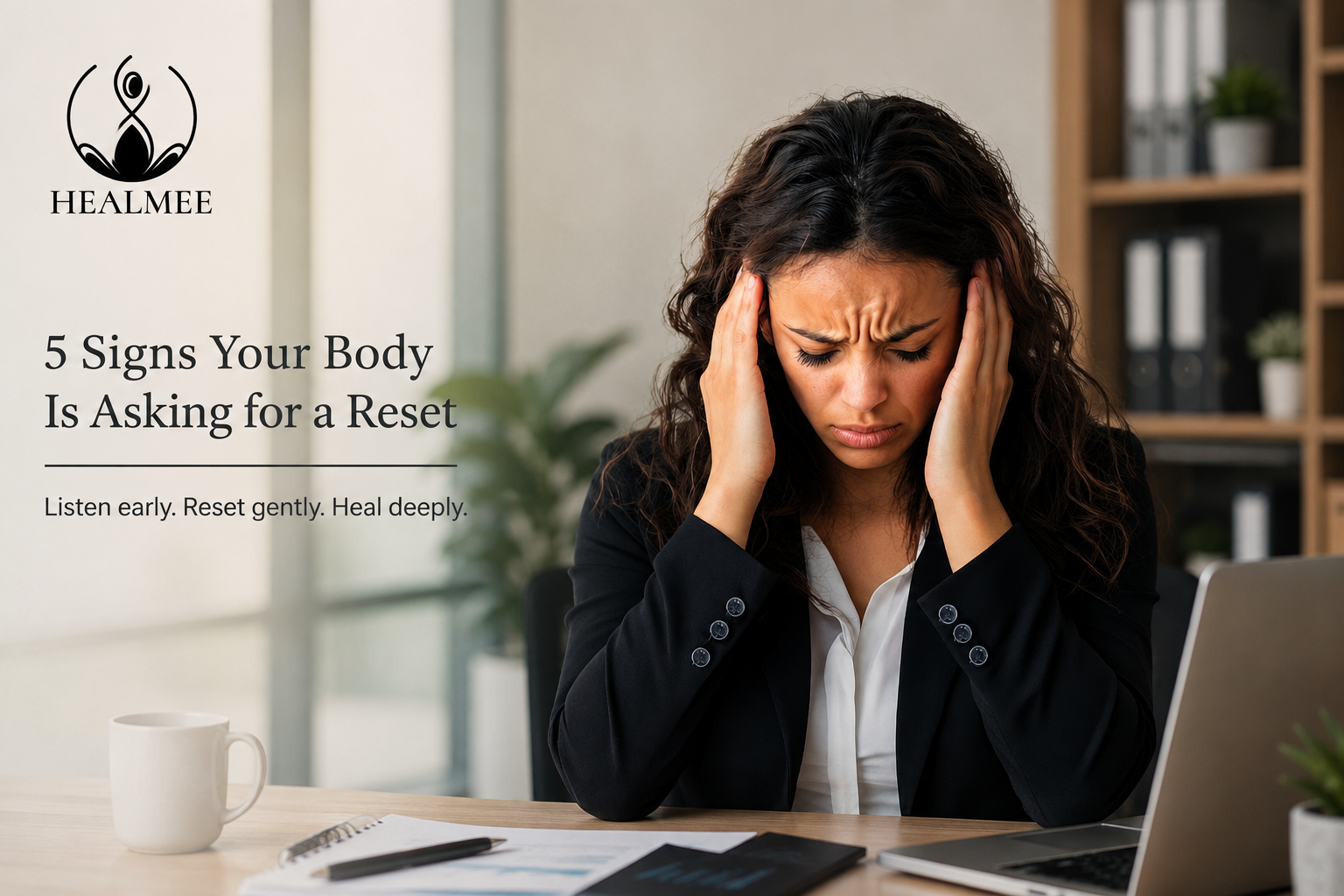
Why emotional exhaustion often appears in the body before the mind fully understands it
Imagine this.
Your team at work seems happy because the numbers are performing well.
Your family appears content because you recently took them on a weekend break.
-Responsibilities are being handled.
-Targets are being achieved.
-Life externally looks stable.
Then suddenly, around Monday afternoon, you feel unusually exhausted.
Not physically weak or sick.
Just internally drained for reasons you cannot fully explain.
Ever wondered why?
This is exactly why 5 Signs Your Body Is Asking for a Reset is becoming such an important conversation in modern life.
-Many people today are not simply tired because they are working hard.
-They are emotionally overloaded while continuing to function normally.
According to the UK Mental Health Foundation – Stress Statistics, stress continues to significantly affect emotional health, sleep, concentration, and overall wellbeing.
However, emotional exhaustion rarely appears overnight.
Instead, the body often starts communicating through subtle signs long before the mind fully understands what is happening internally.
Therefore, learning to recognise these signals early has become deeply important for emotional wellbeing, nervous-system regulation, and long-term mental health.
1. You Feel Tired Even After Resting
One of the most common signs the body is asking for a reset is feeling exhausted despite getting sleep or taking breaks.
Many people assume tiredness only comes from physical activity. However, emotional overload and nervous-system fatigue can also create deep exhaustion internally.
For example:
-constant mental stimulation
-emotional suppression
-prolonged stress
-overthinking
-workplace pressure
-digital overstimulation
can all keep the nervous system in a prolonged state of alertness.
As a result, the body may rest temporarily while the mind never fully switches off.
Consequently, many people wake up feeling mentally heavy even after sleeping.
This is often not laziness.
It is nervous-system exhaustion.
2. Small Things Start Feeling Emotionally Heavy
Another important sign is when everyday situations begin feeling disproportionately overwhelming.
For instance:
-minor delays trigger irritation
-simple conversations feel draining
-emotional patience becomes shorter
-small responsibilities feel mentally exhausting
Meanwhile, many people continue believing they simply need “more motivation” or “better discipline.”
However, emotional overload often reduces the nervous system’s ability to regulate stress effectively.
Therefore, the issue may not always be capability.
Sometimes the system itself is asking for recovery.
3. Your Mind Struggles To Feel Quiet
One of the hidden effects of modern life is constant mental noise.
Many individuals now struggle to experience genuine stillness internally.
Even during moments of rest, the mind often remains occupied with:
-future worries
unfinished tasks
-social comparison
-emotional pressure
-overstimulation from constant information
As a result, people become physically present while mentally disconnected from calmness.
According to the NHS Every Mind Matters – Stress and Anxiety, prolonged stress can affect sleep, concentration, emotional regulation, and overall mental wellbeing.
This is why many people today are not only physically tired.
They are mentally overstimulated.
And eventually, the body starts asking for stillness.
4. You Feel Disconnected From Yourself
One of the deepest signs the body is asking for a reset is emotional disconnection.
Many individuals continue functioning externally while internally feeling:
-emotionally numb
-disconnected from joy
-unable to feel fully present
-distant from themselves
The difficult part is that this often develops slowly.
Modern life constantly pulls attention outward:
-work,
-notifications,
-pressure,
-expectations,
-responsibilities,
-and endless stimulation.
Meanwhile, very little space remains for:
-awareness
-reflection
-emotional processing
-stillness
-nervous-system recovery
Consequently, people slowly lose connection with their own inner state.
And eventually, emotional exhaustion starts feeling normal.
5. Your Body Feels Constantly “On Edge”
Many people today unknowingly live with a nervous system that rarely feels safe enough to fully relax.
This may appear as:
-difficulty switching off
-restless sleep
-jaw tension
-shallow breathing
-emotional reactivity
-inability to relax deeply
Although these signs may initially appear small, they often indicate that the nervous system has remained in prolonged survival mode.
Therefore, the body is not necessarily “failing.”
It may simply be signalling that recovery, regulation, and emotional balance are needed.
Why Awareness Matters?
One of the biggest misconceptions about emotional wellbeing is that people should only slow down once burnout becomes severe.
However, awareness allows people to notice the signals earlier.
This is important because healing does not always begin with dramatic change.
Sometimes it begins with:
-rest
-emotional honesty
-nervous-system awareness
-healthier boundaries
-moments of stillness
-conscious breathing
-reconnecting with the body
At Healmee, one of the strongest observations we continue noticing is that many individuals are not lacking strength.
They are simply emotionally overloaded while trying to function normally.
And eventually, the body begins communicating what the mind has ignored for too long.
Final Thought
The body rarely works against us.
More often, it works for us by signalling when something internally needs attention.
-Perhaps exhaustion is not always weakness.
-Or it is communication.
-And perhaps learning to listen earlier is one of the most important forms of emotional wellbeing in modern life.
Because sometimes the reset people are searching for externally begins with reconnecting internally first.
