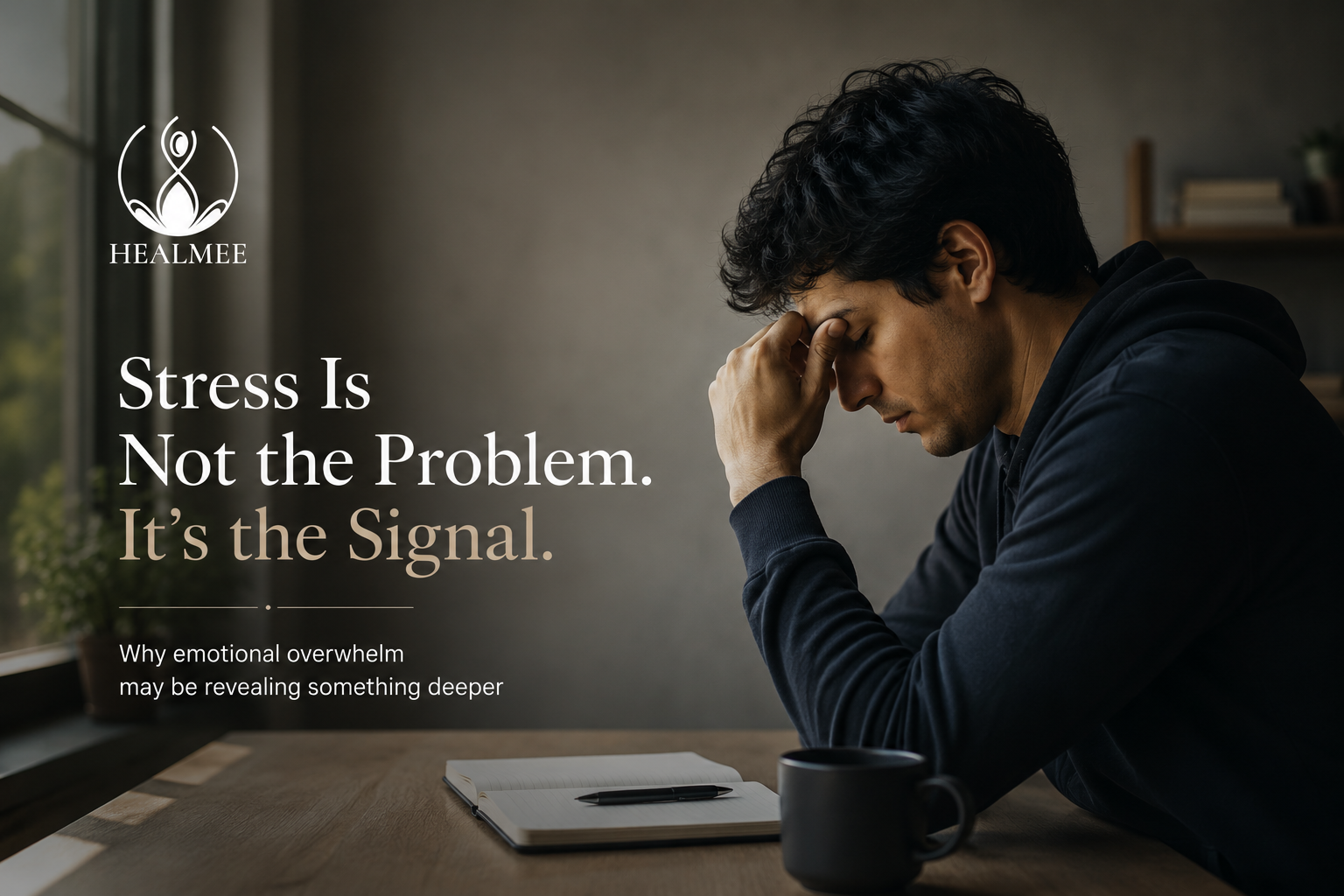
Why emotional overwhelm may be revealing something deeper.
Most people spend their lives trying to escape stress as quickly as possible. However, Stress Is Not the Problem. It’s the Signal many people fail to understand until emotional exhaustion, anxiety, or mental overload begin affecting daily life more deeply.
Today, stress is often treated as something to suppress, avoid, or push through. As a result, many individuals continue functioning externally while internally feeling disconnected, overwhelmed, and emotionally drained.
According to the American Psychological Association – Stress Effects on the Body, chronic stress can affect emotional wellbeing, sleep, focus, immunity, and long-term physical health.
Therefore, the deeper conversation is no longer only about “removing stress.”
It is about understanding what the stress may actually be trying to communicate.
Because sometimes stress is not simply the problem.
Sometimes it is the signal asking for awareness.
The Body Often Speaks Before The Mind Understands
One of the most overlooked aspects of emotional wellbeing is that the body frequently recognises imbalance before the conscious mind fully processes it.
For example, many people continue saying:
“I’m fine.”
However, the body often responds differently.
The jaw tightens.
Sleep becomes lighter.
Breathing changes.
Mental restlessness increases.
Patience becomes shorter.
The mind struggles to switch off.
Although these signs may initially appear small, they often indicate that the nervous system has been under prolonged emotional pressure.
Meanwhile, many individuals continue ignoring these signals because functioning under stress has become normalised in modern life.
As a result, people slowly disconnect from calmness without even realising it.
Eventually, emotional overload begins affecting:
- clarity
- relationships
- productivity
- emotional resilience
- communication
- decision-making
- overall wellbeing
This is why stress management today requires deeper awareness rather than temporary distraction.
Stress Is Sometimes A Signal Of Misalignment
Many people assume stress only comes from being busy. However, emotional overwhelm often develops from much deeper internal patterns.
For instance:
- suppressed emotions
- unresolved emotional pressure
- overstimulation
- unhealthy environments
- lack of emotional recovery
- constantly prioritising external expectations over inner balance
Over time, the nervous system begins responding.
Not to punish.
But to communicate.
This is an important shift in perspective because it changes how people relate to stress entirely.
Instead of viewing stress only as an enemy, individuals can begin asking:
“What is this feeling trying to show me?”
Consequently, awareness becomes the first step toward emotional clarity.
Why Modern Life Keeps People In Survival Mode
One of the biggest challenges in modern workplace culture is that people are often rewarded for functioning while silently overwhelmed.
Employees are praised for:
- staying constantly available
- multitasking continuously
- responding instantly
- pushing through exhaustion
- suppressing emotions to remain “professional”
However, over time, this creates a workplace environment where survival mode becomes normalised.
Many professionals now begin their day already mentally fatigued before work has even fully started. Then, throughout the day, constant notifications, back-to-back meetings, unrealistic responsiveness, and emotional pressure keep the nervous system in a prolonged state of alertness.
As a result, the body rarely experiences true recovery.
According to the UK’s Health and Safety Executive (HSE) – Stress and Mental Health at Work, work-related stress, anxiety, and depression continue to significantly affect employee wellbeing and productivity across Britain.
Therefore, workplace stress today is no longer only about workload.
It is about prolonged emotional and neurological pressure without adequate recovery.
Eventually, survival mode begins affecting:
- communication
- creativity
- patience
- emotional resilience
- leadership quality
- sleep and mental clarity
This is why many individuals feel exhausted even after resting.
Because the body may pause temporarily while the nervous system remains active internally.
Awareness Is The Beginning Of Change
Healing does not always begin with “fixing.”
Sometimes it begins with noticing.
Noticing how emotionally overloaded the mind has become.
Noticing where stress has silently become normal.
Noticing how constantly “holding it together” can slowly disconnect people from themselves.
This is where awareness-based inner work becomes deeply practical.
Because awareness changes how people:
- regulate emotions
- respond to pressure
- experience relationships
- communicate
- make decisions
- reconnect with inner calmness
At Healmee, we often see individuals who initially believe stress is the enemy. However, over time, many realise stress was actually highlighting emotional exhaustion, nervous system overload, or imbalance that had been ignored for too long.
In that sense, stress was not only the problem.
It was also the signal.
Practical Ways To Support Emotional Recovery
Although stress cannot always be completely avoided, emotional recovery can absolutely be supported intentionally.
For example:
- conscious breathing practices
- reducing overstimulation
- mindfulness and meditation
- emotional expression
- proper rest
- nervous system regulation
- healthier boundaries
- moments of stillness throughout the day
Even small awareness-based practices can gradually help the mind and body feel safer, calmer, and more balanced over time.
Most importantly, people must stop viewing stress as personal failure.
Because emotional overwhelm is often the body asking for attention — not punishment.
Final Thought
Modern life teaches people to override themselves constantly.
However, the body and nervous system rarely stay silent forever.
Eventually, stress begins appearing not as weakness — but as communication.
Perhaps the real question is not:
“How do I stop feeling stressed?”
Perhaps the deeper question is:
“What is this stress trying to tell me that I have not fully listened to yet?”
Because sometimes the signal changes everything once it is finally understood.
FAQ Schema
Is stress always harmful?
No. Stress is not always harmful. In many situations, stress is actually nature’s way of pushing people into action, adaptation, and growth.
For example, children often experience stress before examinations. However, that temporary pressure can encourage preparation, focus, learning, and eventually personal growth once the challenge is overcome.
Similarly, short-term stress can sometimes help individuals:
- stay alert
- improve performance
- respond to challenges
- build resilience
- move beyond comfort zones
However, the problem begins when stress becomes constant and unresolved.
Persistent emotional pressure without proper recovery can gradually affect the nervous system, emotional wellbeing, sleep quality, relationships, productivity, and overall health.
Therefore, temporary stress can support growth.
But prolonged survival mode can become emotionally and physically harmful over time.
Why do I feel stressed even when life seems normal?
Many people experience emotional overload due to chronic mental stimulation, suppressed emotions, nervous system exhaustion, or prolonged survival mode.
Can emotional stress affect the body?
Yes. Emotional stress can affect sleep, breathing, focus, energy levels, immunity, digestion, and overall wellbeing.
What does it mean when stress becomes constant?
Constant stress may indicate that the nervous system has not fully recovered from prolonged emotional or mental pressure.
How can awareness help with stress?
Awareness helps individuals recognise emotional patterns, mental overload, nervous system imbalance, and emotional triggers more consciously, allowing healthier recovery and emotional regulation.
